
Meet Superforecaster® Malcolm Murray
“In AI, there’s no point in making random predictions. But there is still a great need for detailed and elaborate forecasts.”

Malcolm Murray is an AI risk management expert who qualified as a Superforecaster in Season 3 of the Good Judgment Project. As Chapter Lead for the International AI Safety Report, he is a core part of the team leading the work of 100 global AI experts. As Research Lead at SaferAI, he provides policy recommendations and risk management tools to governments and AI companies. Originally from Sweden, he is currently based in Abu Dhabi. He is a Research Affiliate with the Centre for the Governance of AI, a Chartered Financial Analyst (CFA) and holds an MBA from INSEAD.
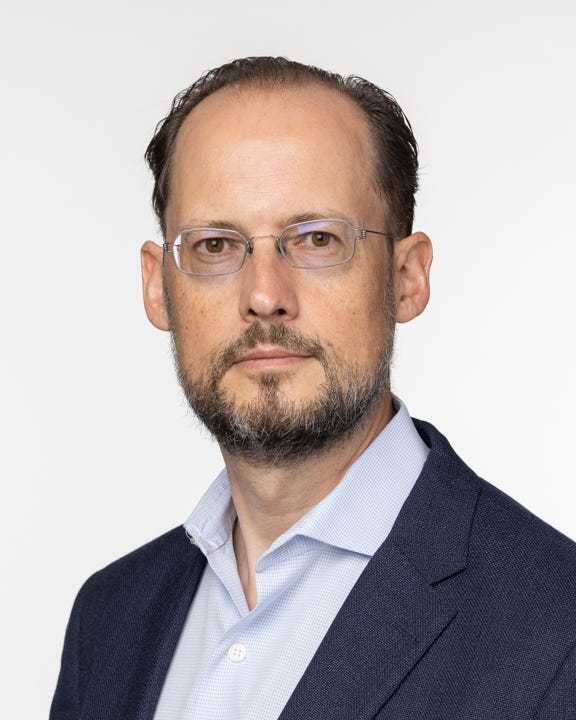
GJ: Could you please tell us how you first became a Superforecaster?
I learned about the Good Judgment Project from a David Brooks column in the New York Times. I registered, participated in Season 3, scored in the top 2%, and so became a Super. I was a Super in Season 4, and then there was a conference in Berkeley with Philip [Tetlock], Terry [Murray], and everybody. As the GJP transitioned into Good Judgment Inc, I kept forecasting. It suits me very well. I’m a classic news junkie. I read everything. It’s fun to apply that, because otherwise you’re not going to discuss, say, the latest situation in North Korea with your friends.
GJ: You wear several hats: Superforecaster, Chapter Lead for the International AI Safety Report, Research Lead at SaferAI. How has your Superforecasting work informed your approach to AI safety?
The Superforecasting work is important for every other piece of work I do. When it comes to the future of AI and the effects it will have on society, I look across the board at all these different AI risks, and a lot of that is forecasting. Both risk management and forecasting are about looking into the future: thinking about uncertainties and looking at what would make an event more or less likely.
Then, very practically, I’ve been doing quantitative risk assessment for AI since I moved full-time into this field about two and a half years ago. We’ve been running Delphi studies where I’ve taken a lot of principles from Superforecasting, both the principles from Philip Tetlock’s work and the best practices I’ve picked up myself. We make sure that the participants are in a group, so that they get to discuss with each other. They are asked to write good rationales that the others can read and then update their views. I’ve been thinking about having dedicated red teams and blue teams, like we have in Good Judgment. I haven’t tested that yet, but we did have one Superforecaster join a session to red-team the thinking of AI experts in cyber risk and biological risk.
We also published a paper at the end of last year on risk modeling in AI, where any Superforecaster or any reader of Phil Tetlock would recognize such components as thinking probabilistically. This is such a useful skill.
And then, being a Superforecaster is a badge of respect. You are a part of a bigger group, and having done this for more than a decade gives you additional credibility and respectability.
GJ: Over a year ago, you wrote on your Substack that “when it comes to AI evolution, prediction seems dead.” But you were careful to distinguish prediction from forecasting. Could you elaborate on that distinction?
It’s a key difference. The AI field has always been full of people making predictions in a way that is very different from Superforecasting. When you look at early artificial intelligence back in the 1950s, the participants, including some great thinkers, predicted they would solve artificial general intelligence in a summer. Geoffrey Hinton in 2016 said that we should stop training radiologists because AI would be able to do their work fully in five years. And here we are, 10 years later. Yes, there are parts of the job that AI can do better than humans, but only a small part, right?
Superforecasters approach forecasts analytically, in a robust way: what is the base rate and what are the various factors that influence it? Prediction is definitely not that, and I think in AI, there’s no point in making random predictions. But there is still a great need for detailed and elaborate forecasts.
[…]
Malcolm also discusses whether Superforecasters were more on the money about AI timelines, the “extreme jaggedness” of AI, and his advice for improving your forecasting skills.